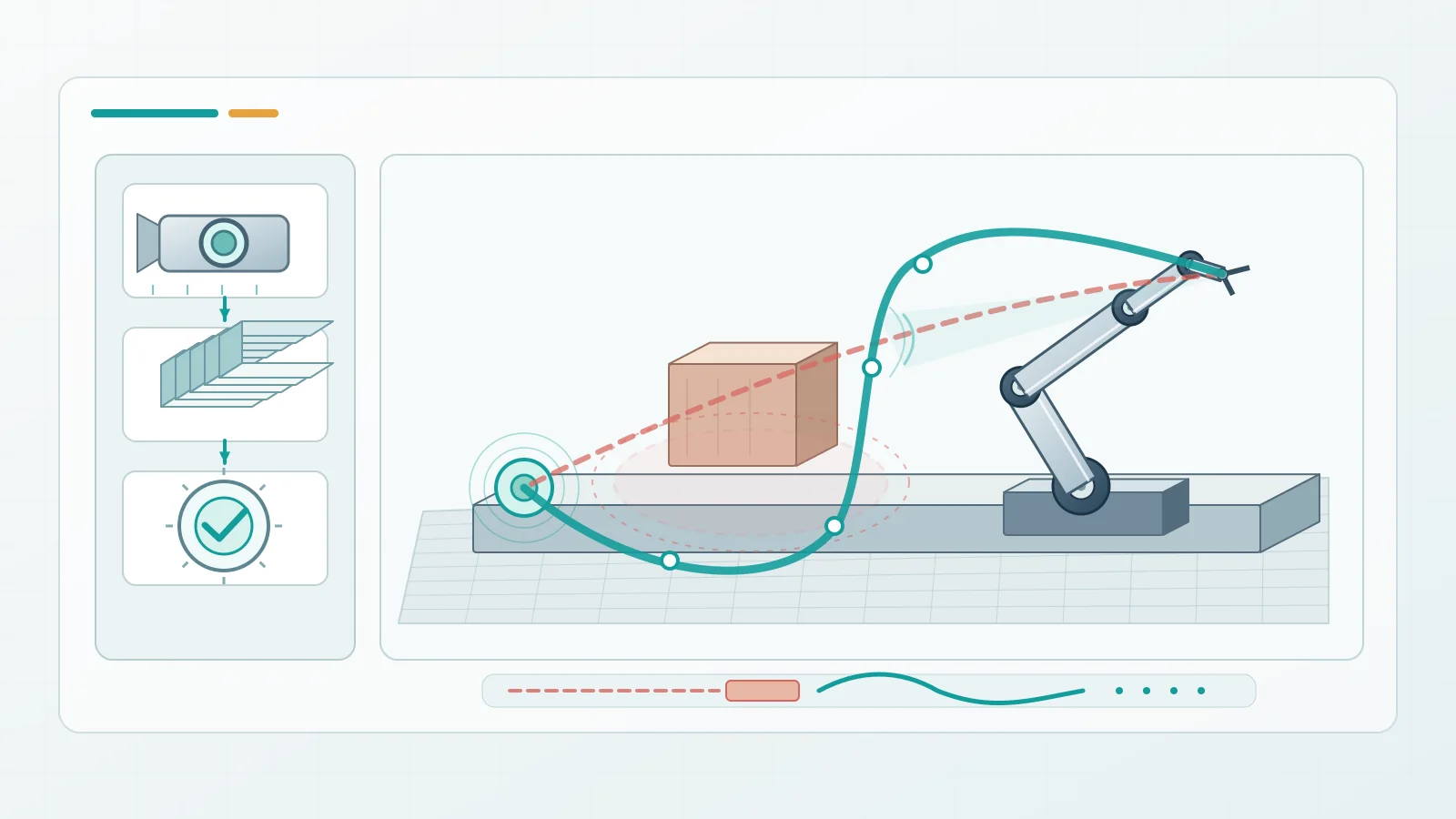
AI-generated illustration · AI-generated technical diagram: a local safety controller adjusts a VLA reference trajectory to avoid an obstacle. This illustrates a general principle, not a specific experimental result.
A VLA can understand a command and still drive an arm into an obstacle. VLA-Stem addresses that gap without retraining the base model. It turns predicted action chunks into motion references and adds a faster local controller that adjusts execution using robot-state and obstacle observations.
Making manipulation faster does not always require a bigger neural network. TOPS changes where flow-based action generation begins and how it progresses, tailoring the source distribution and transport schedule to the task. The network architecture remains unchanged.
Before a robot can learn a manipulation skill, someone must demonstrate it. OpenJaws records those examples without a robot: an operator moves a camera-equipped handheld gripper, and stereo vision reconstructs motion at metric scale. That avoids the absolute-scale ambiguity of monocular tracking.
A robot may execute its program while failing the task: grasping empty space, for example, or proceeding before a drawer opens. RoboAuto puts physical verification into program search. It stores knowledge of objects and possible interactions, grounds it in the current scene and runs small experiments when competing explanations remain.
Walking is of little use when a passage is lower than a humanoid's torso. REACH gives the Unitree G1 a way to switch from bipedal movement to crawling and back. A transition policy bridges different contact modes, while LiDAR-based planning anticipates overhead clearance.
Seeing the next foothold is not enough; a humanoid must anticipate when its foot will land and whether the surface can support it. HC2Robot predicts contact timing, position and quality from onboard observations, approximating information available only during simulator training. A Hyper-Connection Transformer combines the temporal signals.
A dexterous hand can reach the right pose and still drop its object. Researchers using the LEAP hand treat that risk as a separate safety problem. They train in simulation without human demonstrations and add an adjustable residual filter to moderate risky actions.
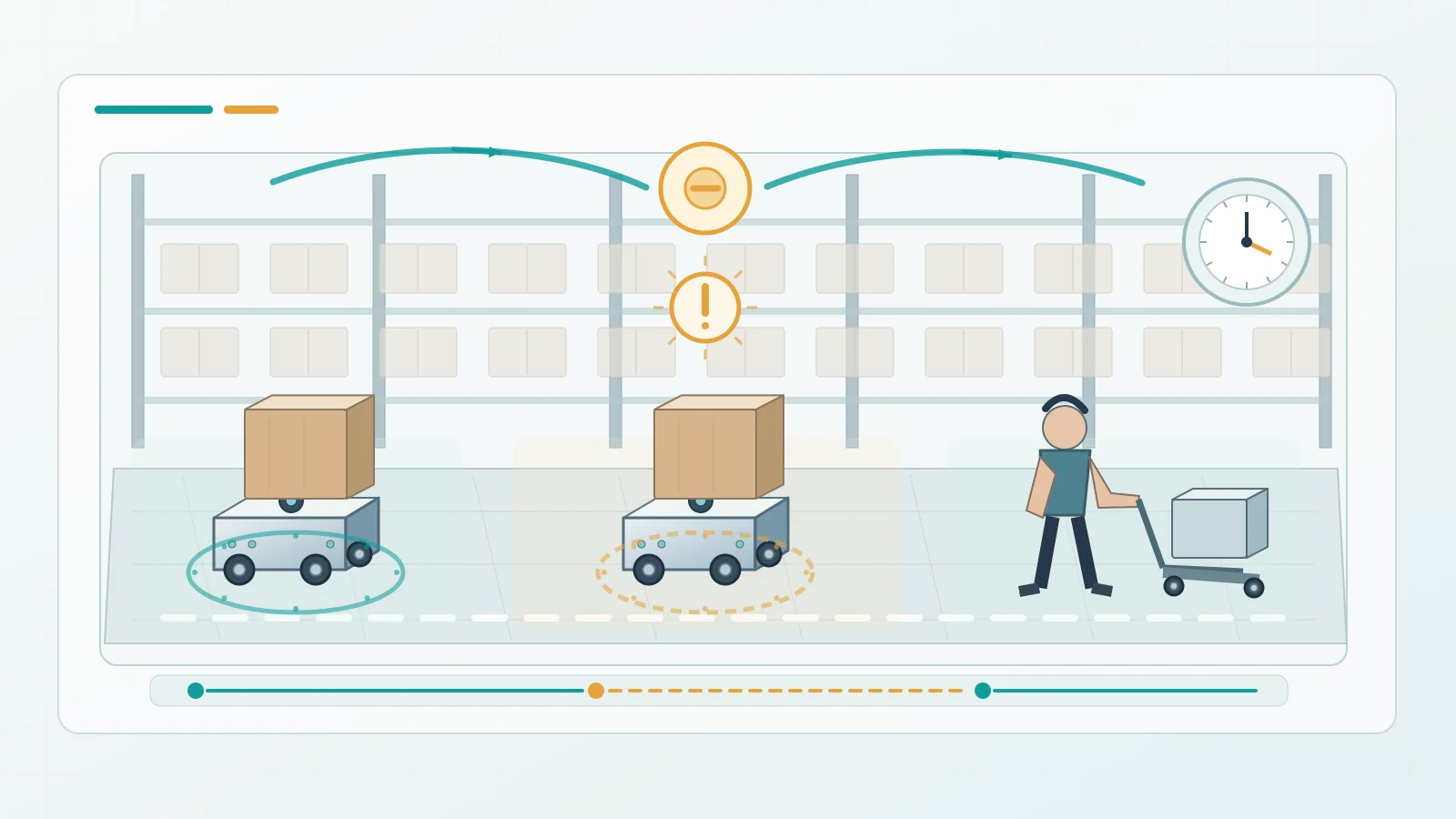
AI-generated illustration · AI-generated conceptual technical illustration: an autonomous transport robot stops and a worker takes over the material-handling task. This is not a depiction of an insurance product.
Robot deployment begins with productivity forecasts. It often ends with a harder question: who pays when the machine stops? Japan's Tokio Marine & Nichido has announced AI Robot Insurance for November 2026, covering specified downtime-related continuity costs alongside equipment damage and third-party liability.